
Common Hallucination Patterns in NLP
Natural language processing (NLP) models sometimes generate hallucinations, where they produce false, misleading, or entirely fabricated information. These hallucinations arise due to the way AI models predict and construct language based on patterns rather than factual understanding. While AI has made significant progress in text generation, summarization, and conversational applications, hallucinations remain a challenge, especially in critical areas like healthcare, law, and finance. Understanding the common patterns of hallucinations in NLP can help improve model reliability and reduce the risk of misinformation.
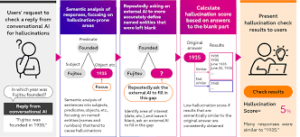
One of the most frequent hallucination patterns in NLP is factual inaccuracy. Al hallucination detection and accuracy improvement generate responses based on their training data, but they do not have real-world understanding or direct access to up-to-date knowledge unless explicitly connected to external databases. As a result, they may confidently state incorrect facts, misattribute sources, or fabricate details that seem plausible but are entirely false. For example, a language model might invent historical events, misquote scientific research, or provide incorrect statistics. This is particularly problematic in applications like news summarization, where fact-checking is crucial.
Another common pattern is logical inconsistency. NLP models often produce text that contradicts itself within the same response or across multiple interactions. This happens because AI models generate responses based on probability rather than true reasoning. A chatbot, for instance, might claim in one response that a particular company was founded in 1990 and then later state it was founded in 2005. Logical inconsistencies reduce trust in AI-generated content and make it difficult for users to rely on such models for accurate information.
What Are Common Hallucination Patterns in NLP?
Fabrication of references is another hallucination pattern, particularly in AI models designed for academic writing, research assistance, or citation generation. AI may generate realistic-looking references, including author names, publication titles, and journal names, that do not actually exist. This can mislead users into believing false citations are valid, which is a significant issue in scholarly work. In legal and scientific contexts, fabricated citations can lead to serious credibility and ethical concerns.
Misinterpretation of ambiguous input is also a frequent source of hallucinations in NLP. AI models struggle with understanding nuance, sarcasm, or indirect language. When faced with ambiguous queries, they may generate confident but incorrect responses rather than seeking clarification. For example, if asked about a medical symptom with multiple possible causes, an AI model might provide a definitive answer rather than acknowledging uncertainty. This can be dangerous in applications like AI-powered medical assistants, where misinformation could impact health decisions.
Another hallucination pattern is excessive verbosity, where models generate responses filled with unnecessary or incorrect details to make the output appear more authoritative. Instead of simply stating that they do not have information on a given topic, models may produce long explanations that contain speculative or misleading information. This pattern is particularly concerning in automated customer support, where incorrect but convincing-sounding information can lead to user confusion or frustration.
Addressing hallucination patterns in NLP requires continuous model improvement through better training data, reinforcement learning, adversarial testing, and retrieval-augmented generation. By understanding and mitigating these hallucination tendencies, AI developers can create more reliable and trustworthy language models that enhance human-AI interaction without compromising accuracy or truthfulness.